woman yelling

Just Because We Don’t Have What You Want, Doesn’t Mean I Don’t Care

woman yelling

As owner of an eco-fashion store, I get a lot of great emails, but every once in a while I get a crazy, nasty e-mail.  Most often, it’s because I don’t carry someone’s size, but several other varieties of nasties also wind up in my inbox. 

We’re getting a little more exposure lately, and with it, an up-tick in nasty e-mails.  Last week I received three; two were variations of size-related issues and the last was a rant that I’m a fake vegan because we carry 5 items (out of 951 currently in stock) that are made using free-range, hand-sheared alpaca.  One actually ended in “you disgust me.”  No, I’ve never met this person nor interacted with them in any way prior to receiving the e-mail.

Admittedly, our Plus Size selection isn’t as extensive as I might like.  With my strict criteria about fabric, finishes, dyes and human rights, plus sizes are just not that easy to come by.  I was very excited to find a new plus size eco-fashion source recently, and am happy to be expanding our plus selections this summer. 

Accusations are Unhelpful
Most of the women in my family are heavy, and it’s always been important to me that I carry items that my family could wear and enjoy.  So please don’t write to tell me, “You hate fat people,” “You can’t relate to larger women,” or “You’re not a real environmentalist,” just because I don’t carry or have something you like in your size. 

On the other hand, if you know of a brand that carries what you want, let me know.  We’ve looked into many overseas brands by request of our customers.  Some don’t export to the USA, some are very expensive or have high minimum orders that we were unable to meet.  But a few have been matches, and we’ve added several brands based on customer suggestions that are hard to find in the USA.

Show Some Compassion
I struggled with carrying alpaca, but started because several (eco-conscious but not necessarily vegan) customers explicitly asked me to find warmer coats that were truly eco.  The amazing folks at Indigenous Designs took a written stand against mulesing when approached by PETA, and really do care about the welfare of the animals that are sheared.  From their website:

Indigenous sources the majority of our alpaca fiber from outside of Arequipa, Peru in the Puno and Cusco areas, close to many artisan work groups. These alpacas are free range roaming animals with pasture rotation. The alpacas are not fed hormones and do not receive chemical dippings for ticks or parasites. There are no chemical ingredients allowed on the land or animals.

The thing is, these are just this week’s criticisms.  Every decision I make for this business is made thoughtfully. And while I would certainly not expect everyone to agree with all of them, it would be really nice if folks could avoid accusations and name calling and perhaps ask me why things are a certain way. 

Ok, in all fairness, the vast majority of e-mails and calls we get do exactly that.  So I ought to be able to just shake off this vocal minority who sends nasty notes.  But it’s hard. 

Remember People Have Feelings
This business is my passion and it means a lot to me.  It particularly stings when someone accuses me of being solely profit-driven since I earn half my previous corporate salary running my own business, and work twice the number of hours.  (I wish that were an exaggeration, but it’s not.)

Earlier this week, I saw another small business owner noting how badly they felt when they were openly criticized. So I’m writing this post for three reasons.

  1. I know the majority of my customers and readers are fantastic, understanding, socially conscious, super stars and after a week of hurtful comments, I’m reaching out to offer up some love to the good guys! 🙂
  2. To share my experience with other solopreneurs and small-business owners so they can step back, like I’m trying to do, and realize that it really is impossible to please everyone and that we shouldn’t let one person ruin our mood or our business.  It truly is impossible to please 100% of the people.  Just do your best.
  3. To provide a useful quick-link response to future e-mailers. If I sent you this link as a response to an e-mail, try e-mailing me back with a bit more civility. I’d be happy to answer your question, help you find something, or even explain my decisions as long as your remember that I’m a real, live person, not a corporate entity.  And I have feelings that can be hurt.  So please show a little respect and kindness and I’ll do everything I can to do the same.

With Love, Adrienne
Share this article:
better living show

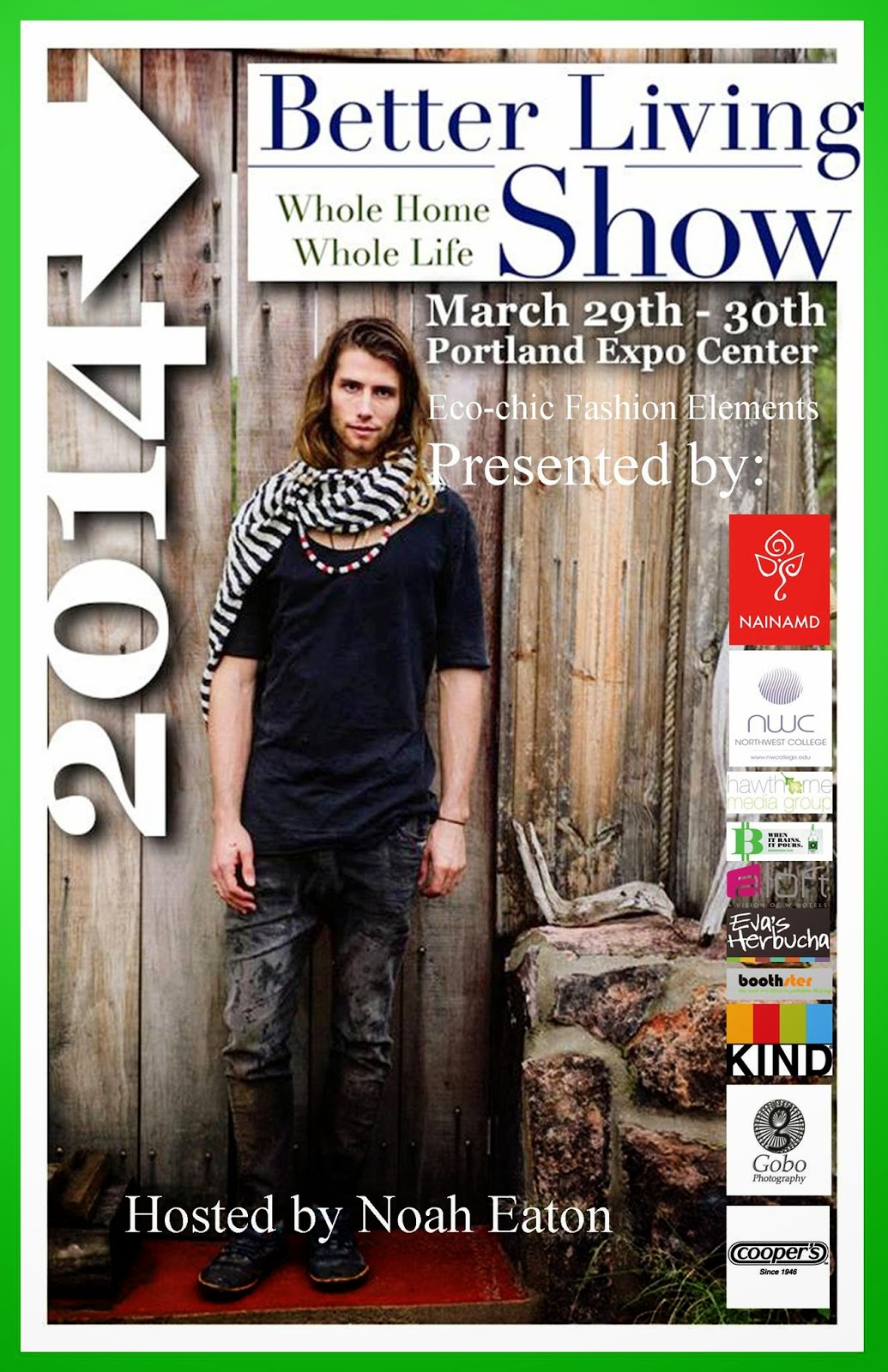
Come See Us at Portland’s Better Living Show March 29-30

We’re going “live”!  If you live around the Portland, OR area, come visit Faerie’s Dance – along with other sustainable companies – at the Better Living Show on March 29 – 30, 2014 at the Portland Expo Center.  Admission is FREE.  Take a moment to touch and feel some of the wonderful fabrics we’ve been writing about lately.

We’ll be part of the Semper Fashion Eco-Fashion Show and you’ll have the opportunity to see several of our styles on the runway.  There’s a changing room, so you can try things on, too.

better living show

If there’s something you’ve been wanting to check out, let us know in advance and we’ll be sure to bring it.

This is our first expo in Portland, and I’m pretty excited about it.  I look forward to meeting some of you in person.

Share this article:
flax plant

Which Fabrics are the Most Eco-Friendly?

You want to be eco-friendly, but you’ve read bad things about bamboo, you’ve never heard of Modal® and you have no idea where linen fits into all of this.  No worries, FaeriesDance.com has you covered.

There are 3 factors considered when determining the most eco-friendly fabrics:

  • The sustainability of the input materials,
  • The harshness/toxicity of any chemicals required for processing,
  • Production waste.

With that in mind, here’s our well-reasoned and researched (but not scientifically tested), Most Eco-Friendly Fabrics list.

1. Hemp
Marijuana’s non-psychotropic cousin leads the list in eco-friendly fabrics.  It is indeed a weed, growing prolifically without the need for pesticides, herbicides or extensive amounts of fertilizer.  It uses very little water compared to other fabric crops.  Hemp stalks can be directly spun into yarn without any chemical inputs and there is essentially no production waste from yarn to fabric.  Hemp was used extensively in the USA up until 1937 when it was included in the Marijuana Tax Act. Since industrial hemp cannot be used as a stimulant, there is some speculation that it was included in the Act as a way to minimize competition for timber-based paper and nylon fabrics. The first USA flag was made from hemp.

2. Organic Linen

flax plant

The Flax plant is moderately easy to grow, and when grown organically without chemical pesticides or herbicides, is very eco-friendly.  The outer layers must be retted to get to the inner core which can be directly spun into yarn.  Retting of organically grown flax can be done with water alone; no chemicals are required.  Only natural, biodegradable waste products are produced.

3. Organic Cotton
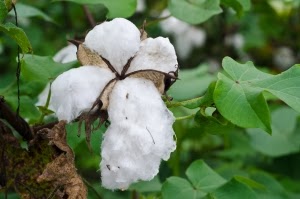
Cotton is a very water-intensive crop.  So even organically grown cotton, which can be spun directly into yarn, falls lower on the eco-scale than hemp or linen; while conventionally grown cotton is off the eco-chart completely.  Organic cotton is the most commonly used eco-fabric as it’s softer than hemp and doesn’t wrinkle like linen does.  It’s readily available, reasonably priced, and one of the most versatile fabrics on the list.

4. Tencel® / Modal®
There’s a tie at the number 4 spot between two Lenzing developed fabrics, Tencel and Modal®.  Both fabrics are man-made from tree cellulose using Lenzing’s eco-award winning processes which include low-toxicity chemicals along with closed-loop, very low waste, production systems.  The resulting fabrics drape beautifully.  Tencel® has been shown to have moisture management and bacterial resistance properties, while Modal® has unparalleled softness.  Seriously, even cotton seems rough next to Modal’s liquid silk feel.

5. Bamboo / Soy

soy plant

Spot 5 results in another tie, this time between Bamboo and Soy fabrics.  Both of these have fantastic input materials.  Bamboo is the fastest growing woody plant on the planet. (It’s actually a member of the grass family.)  Soy is created using the discarded, inedible outer casing of soybeans, essentially reclaiming a waste product.  While 89% of USA grown soy is now GMO, most soy fabric is made in China using non-GMO soy.  Unfortunately, in 2013, China approved the import of GMO soy seeds.  So this will be something to watch in the future.  The reason these two near-perfect input materials are way down at number 5 is that both require a fair amount of chemicals to process into fabric.  So they fall lower in the chemical and production waste categories.

6. Recycled PET
This video is the best one we’ve seen on the details of how to turn plastic bottles into polyester fleece clothing.  In truth, putting this at number 6 versus number 5 is fairly arbitrary.  This is a very energy-intensive process, but requires fewer chemicals than in bamboo or soy fabric production.  So it’s a little hard to judge which is better.  Polyester is very beneficial in some applications like swimwear, and keeping all that non-biodegradable plastic out of our oceans and landfills is a very good thing.

Caveats
Choosing any of these fabrics over conventional cotton, polyester, nylon or rayon is a big step in the eco direction.  However, fabric is only one piece of the eco-friendly puzzle.  The very cleanest hemp fabric that is conventionally dyed and doused with chemical finishes will fall lower on the sustainability scale than a low-impact dyed bamboo with no finishing agents.  If you choose something certified under Global Organic Textile Standards (GOTS) or OEKO-TEX 100 standards, you can be certain the dyes and finishes are non-toxic and free of harsh chemicals.

Workers rights and Fair Trade practices should figure into your evaluation of eco-friendly.  One can argue whether a fair-trade, conventional cotton shirt is better or worse than an organically-grown cotton shirt made under unsustainable working conditions such as those in the recent Bangladesh incident.  Happily, GOTS certification also includes some reasonable working condition requirements for employees.

Intentionally missing from this list are controversial animal-derived fabrics such as wool and silk.  Hand-sheared, free range wool can be very high on the eco-scale (perhaps second or third), providing a synergistic (and often caring) relationship between the sheep and the farmer.  However, mass-produced wool using mulesing and factory-farming techniques has no business in eco-fashion.

Share this article:
fabric

What are “Natural Fabrics”?

fabric

Some companies use the term “natural fabric” for apparel or linens as a means of green-washing products that may be laden with pesticides, chemicals or other yucky stuff that is by no means sustainable or eco-friendly.  There’s no legal definition of a natural fabric, the way there is of a certified organic fabric, so it’s important to understand what the term implies.  People also toss out phrases such as “man-made fabrics” or “synthetic fabrics.”  Does that make them bad?  And what’s the difference?

Since there’s no legal definition, the following are the most common interpretations of the terms.  More importantly, though, understanding what goes into each fabric will help you make a more informed decision about what you choose to put on your body regardless of what it’s called.

Natural Fabrics

cotton plant
Cotton plant

There is a set of input materials found in nature that can be directly woven, knit or cured into fabric with no or at most minimal processing.  That is, the final fabric looks and feels very similar to the original source material.  By that definition, cotton, hemp, flax (linen), jute, ramie, wool, silk and even leather are considered natural fabrics.

It is important to note here that “natural” doesn’t necessarily mean eco-friendly; nor does it imply vegan or even chemical-free.  It’s simply that the input material is found in nature (as a plant or animal) and can be directly turned into fabric.

Man-made Fabrics

bamboo plant

Man-made is a particularly odd term since really all fabric is made by humans.  Cotton doesn’t go weaving itself while we aren’t looking.  But ok, we can move past the misnomer.  There are a set of fabrics that start with natural inputs, but require so much processing that the final fabric doesn’t look or feel anything like the original material.  These fabrics are derived from natural materials. Bamboo is an excellent example.  Most bamboo textiles are created using a viscose process similar to rayon production.  Since the fabric is derived from bamboo versus being directly woven or knit from the bamboo plant itself, it’s considered man-made, not natural.

Man-made fabrics derived from natural materials include rayon, tencel, modal and pine tree fabrics, all of which are derived from various wood pulps, as well as bamboo, biophyl (derived from corn) and rubber (derived from the Hevea brasiliensis tree).

Synthetic Fabrics

polyester fabric

There is another class of man-made fabrics that are derived from manufactured materials.  So the input material has itself already been processed or manufactured from something else. One way to think of it is that fabrics derived from natural materials are “once removed” and fabrics derived from manufactured materials are “twice removed” from their natural source material.  Those terms have no real meaning, but they can be helpful in keeping track.  These are the fabrics most commonly referred to as synthetic fabrics, and include nylon, polyester, acrylic, Spandex, elastane, Lycra and polypropylene.

One caveat is that there are a few cross-over materials.  Unprocessed hemp makes a somewhat coarse fabric that stands up extremely well to washing and wear.  That makes it fantastic for khakis and jeans.  However, it’s a little rough when it comes to shirts.  While hemp blended with other materials like cotton or tencel mostly resolves the softness issue, there is also a class of hemp textiles that are processed as a viscose to provide a truly silky finished fabric.  Therefore, while natural hemp fabric is more common, there is a hemp viscose fabric which is actually man-made.

There’s also a bamboo linen, which is a linen-like material woven from the leaves of the bamboo tree, which is a natural fabric.  It’s much less common than man-made bamboo viscose, though.

An initial reaction might be that natural fabrics are more sustainable than man-made fabrics which are more sustainable than synthetic fabrics.  Alas, that is simply not the case.

Conventional cotton requires enormous amounts of water to grow and accounts for more than 16% of total insecticide use worldwide and nearly 7% of herbicides worldwide.

There are some completely synthetic fabrics that are eco-friendly.  For example, recycled PET is a polyester fleece made from recycled plastic bottles which minimizes land-fill waste and avoids the use of virgin petroleum.

This leads to the next logical question; “Which fabrics are the most eco-friendly?”  This is our next topic in the series.

Share this article:
no wire padded bra

The Elusive Organic No Wire Padded Bra – Why They’re So Hard To Find

no wire padded bra

Our most frequently asked for item is an organic or natural fiber bra without underwire that has padding.  We’ve had a few close designs, but that perfect bra has eluded us.  So what exactly is the issue with getting this holy grail of bras?

We have been lucky thus far to carry the most eco-friendly padded bras in the world.  Love Nature, (the Italian company that recently went on [possibly permanent] hiatus), has been making organic cotton padded bras with an interior cotton batt for the padding.  Conventional bras use either polyester or nylon for the interior padding, both of which are petroleum-based fabrics.  The biggest difference in performance is that polyester can be molded to keep its shape and can be made in a variety of thicknesses.  The cotton batting is designed similar to a quilt and can only keep its shape under certain thicknesses (on the lighter side of padding) and with the help of the underwire to support it.  Love Nature only made underwire padded bras because their eco-padding required the firmness of the underwire to essentially hold it in place.

The lesson is that you can have eco-padding and underwire or conventional padding and no wire. At this point, it doesn’t seem you can have both.

blue canoe adjustable soft bra

In 2011, Blue Canoe came out with their Adjustable Soft Bra and Soft Cup Bra.  Both of these bras have removable nylon pads that sit in organic cotton “pockets” and don’t touch the skin.  These are both pull-on style bras, and in truth, we didn’t think they would do that well.  But Blue Canoe is a trusted brand, so we tried them out… and they are flying out the door.  There are just so many women who want an organic no wire, padded bra that they’re finding conventional padding and no wire the better option.

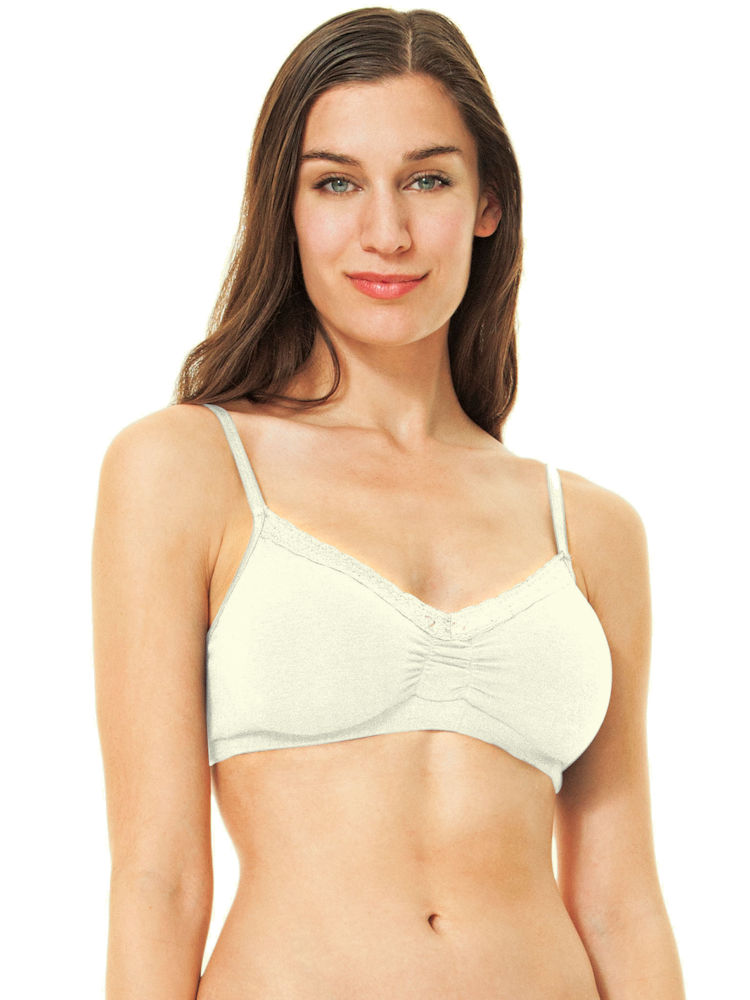
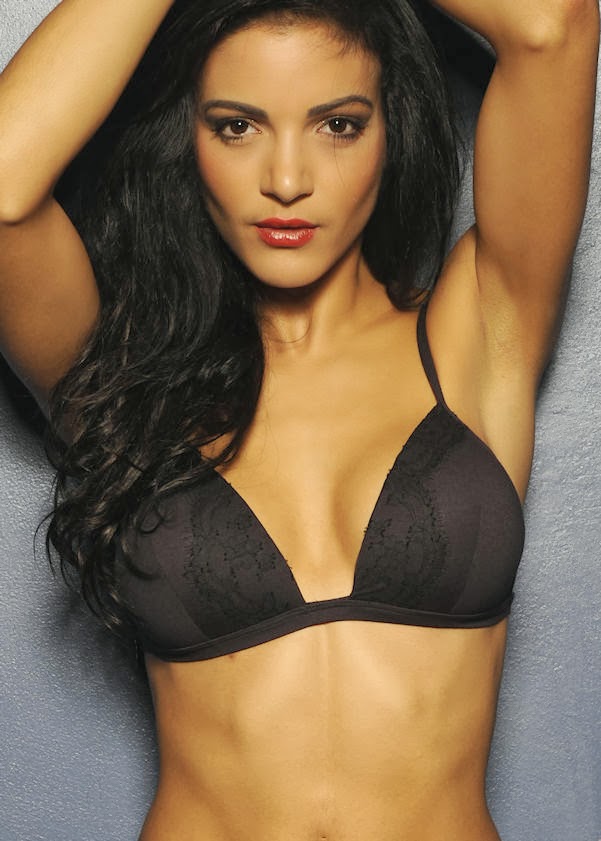
That said, allow us to introduce two fantastic no wire, padded bras with fully adjustable straps and 3-position back closures.  At the top of this page, you’ll see the Body No Wire Padded Bra and here to the right is the Calais Lace No Wire Padded Bra.  Both are made from a unique eco-fabric of white pine tree trimmings and dyed with OEKO-TEX 100 certified dyes.  They do unfortunately have polyester padding, though it does not touch the skin.

bra

On a side note, we’ve quietly had a no wire, padded bra with adjustable straps and 3-position back close all along.  The Pine Tree Padded Bra has been around since 2009.  However, the $80 price tag put it on a very slow sales track.  Another issue with this particular bra is that the criss-cross straps in the back make it a bit awkward to put on.  It has to first be pulled on over the head before you can secure the back hooks.

The Pine Tree Padded Bra was originally made end-to-end in France.  As the company grew, they realized that despite having an awesome fabric their pricing was holding them back.  A few years ago they re-branded as Do You Green and started having the garments sewn in Tunisia while keeping their unique fabric production local to where the pine tree trimmings are collected in France.

We took a look at them then, but were holding out hope that they would get a Fair Trade certification.  We’ve just touched based again, and are happy to report they’ve gone one step further.  Do You Green now has a dedicated factory in Tunisia that allows them to set their own high standards for employees, working conditions and the quality of their garments.  It also allows them to offer their unique Pine Tree fabric garments at much more reasonable prices.

Getting back on topic, we’re unaware of any company in the world who has developed an eco-padded, no wire bra. We’re still looking, though.  And if you ever see one, please let us know.

Share this article:
new year

Greening Your Whole Life: The Turtle Approach

new year

Happy 2014!  You’ve made it through another year and you may already be tackling a list of resolutions.  I’m here to tell you to toss out that list.  Instead, I’d like you to consider this ridiculously slow (and permanent) way to go green and healthy forever.

I used to make loads of New Years Resolutions and, like most other folks, I’d be down to working on just one or two (if any) by February.  It’s hard to change everything overnight.  Especially if the night before was a drunken debacle – or at least a late night with a few too many glasses of wine.  

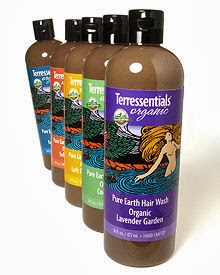
terressentials hair wash

Long before I became a vegan, before I owned an organic clothing shop, before I washed my hair with mud, I was an everyday woman who wanted to green up my life a little and get healthier.  Pretty simple.  Each year I’d make my list and then end up giving most of it up.

That is until one year, I decided to address just one thing

That first year, I took on household cleaners.  That’s it.  I dedicated the entire year to greening up my household cleaners.  There was no big rush on January 1st and nothing overwhelming.  It was just this: as I ran out of each cleaner, I would take the time to checkout what’s in it, what shouldn’t be in it and what I could get to replace it. 

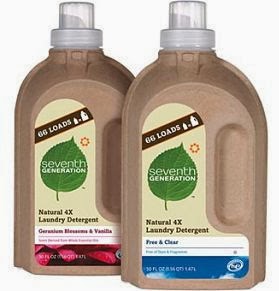
seventh generation detergent

Over the course of 12 months, I switched my laundry detergent, stopped using dryer sheets, got rid of everything with bleach or ammonia in it and effectively changed the look of my cleaning closet.  Of course, it got easier with each cleaner.  I got to know brands I liked and could trust and automatically went to those first when the next cleaner ran out.  The beauty of that concept, was that nothing was wasted.  I didn’t throw a bunch of stuff out on January 1.  I simply switched when I would need to replace anyway.

The next year, I decided to switch out my beauty products.  I found new soaps, lotions, deodorants (that was the hardest one) and hair care.  I purchased my first wood-bristle brush.

The year after that was make-up, which I rarely use anyway.  But I looked into natural mascara, non-toxic lipstick (you shouldn’t have to poison yourself just to look good), and natural mineral powder blush and foundation.

You get the idea.  Just one thing.  Each year.  Consistently.  Food, clothing, cleaners, cosmetics, car, kids toys, you name it.  Even food changes weren’t overwhelming. 

One year, I committed to just consciously looking at the ingredients in every packaged item I purchased.  That’s it.  I could still buy whatever I wanted, but read the ingredients to learn.

The next year I committed to stop eating anything with high fructose corn syrup. 

The thing is, if you have the entire year to make just one commitment, it works.  Living a healthy, green life is great, but you don’t have to (nor would you really want to) change everything all at once. 

I know there’s a lot of change-your-life advice that comes out every January.  I recommend not changing your life.  Just pick one small thing and work it in to what you’re already doing.  By the end of the year, it will be so ingrained you won’t have to think about it any more.  And then you’ll be ready for the next thing.

That’s it.  One small step, taken slowly, will help you be a better you each year than you were the year before. 

Share this article:
Modal Mother Earth Top

Modal is touted as the new eco-fabric; does it live up to the hype?

I’ve been seeing a lot of eco-fashions made from the new fabric, Modal, recently.  Some of the designs are super cute, but I wanted a little more information before jumping in.  I bet you do, too.  Modal is yet another play on Rayon.  It’s got that fabulous rayon drape and soft, silky feel, but is it sustainable?

Modal Mother Earth Top

 I was pleased to learn that Modal was developed by the Austrian company Lenzing, developer of the eco-fabric Tencel. Like Tencel, Modal has earned the European Union EcoLabel for having a reduced environmental impact throughout its life cycle.

Modal comes from Beechwood trees. Beechwoods are self-propagating which means no artificial irrigation or planting is required. More than half of the wood used by Lenzing comes locally from Austria and the remainder is from neighboring countries. All of the beechwood used for Modal comes from forests that follow sustainable harvesting methods.

Notably, Modal is the first fabric considered carbon neutral in its production process.  This is possible due to the generation of excess energy during fabric production and the recovery of component parts of the wood.  Even the pulp production is self-sufficient in terms of energy and is an important supplier of energy for the entire operation. Lenzing also boasts that up to 95% of the production materials are recovered and reused, which sounds very much like a closed-loop production system.

Modal Paw Tee

The key part of the production cycle is Lenzing’s Edelweiss technology: oxygen-based chemistry that eliminates the need for harsh and/or toxic production chemicals

In summary, Modal passes the environmental criteria we set out to meet: sustainable input materials, very low waste production and no harsh or toxic chemicals.  Of course, we also source clothing from manufacturers who use low-impact dyes on the fabric and do not add harsh finishing agents.  With that in mind, our first Modal-based garments are now in and this batch has the bonus of all being designed and sewn in the USA.  Like Tencel, we still plan on using the fabric sparingly in our offerings; but a few awesome pieces are sure to add a bit of variety to your wardrobe.

Share this article:
trebuchet

Organic Cotton Panty Update – Status of Our New Endeavor

In the back of my head, I’d wanted to start my own organic clothing “brand” for some time now.  But it took repeated loss of some of our best selling items for me to finally take the plunge.  I have to say, my initial trepidation was not wholly unfounded.  Designing and manufacturing are a completely different animal than retailing.  There has been so much to learn, including a whole new vocabulary that I was completely unfamiliar with.  Not unexpectedly, spending nearly 3 months focused on learning something entirely new and thus not spending that time on marketing, press releases, creative newsletters, web updates and other normal business tasks has had its effect on sales.

trebuchet

However, my SO has likened the effort to that of a trebuchet being loaded.  While I at first thought he was nuts, I loved his explanation of the slow crank of the trebuchet actually moving the (let’s call it) stone-of-progress away from the goal only to eventually slingshot it forward all in a massive rush.  Being tickled by fantasy novels, Renaissance Faires and period movies, the trebuchet imagery makes me smile and keeps me turning that crank.

While it looks like my goal of having the first organic cotton panties for sale before the holidays is definitely not going to happen, we’re now far enough along that I can provide some details of what’s coming.  Here’s what we’ve got so far…

There are still some vagaries in the schedule that could cause even more delays, but if all goes well, the initial launch of our new brand, Green Tree Organic Clothing, will be in early 2014.  The roll-out of products will be in 3 phases spanning the entire year.

Phase 1: Five panty designs derived from previous best-sellers and a little inspiration, launching in January or February 2014

Phase 2: The addition of panties with lace trims, probably a thong style and possibly our first sports bra and/or cami – some time in Summer

Phase 3: Men’s underwear and whatever else on our list people have been asking for – maybe a simple unisex tee in more color options – hopefully in early Fall

Phases 2 and 3 are *very* vague still and could change.  Phase 1 however, is really coming together.  Here’s what to expect.

bikini pattern
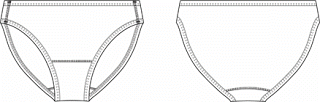
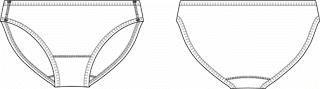
Classic Bikini Style

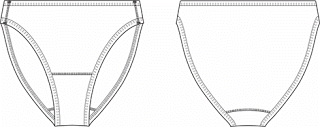
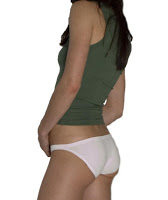
A Classic Bikini and a Hi Cut Brief in 5 colors (black, sweet pink, deep plum [bordeaux], white and undyed natural).  Taking heed of feedback we’ve had on these styles, we’ve kept the same basic shape, but are using a slightly heavier fabric that will not only make these softer, but should also make them last longer. I’ve heard and experienced that the versions we currently carry get threadbare faster than some of the other styles. The new fabric has more cotton per square inch, and while it’s a tad more expensive, it should alleviate that issue.  We’ve kept the same fold-over elastic styling that does touch the skin, but are using a latex-free version making them accessible to more customers.

hi cut brief pattern
Hi Cut Brief Style

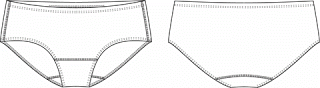
For those with more acute sensitivities, we’ll have a Hipster style with completely covered elastic in black and undyed natural and have changed the design to include flat seam stitching for more comfort.

hipster panty pattern
Hipster Panty Style

The last 2 are really fun styles and my personal favorites.  We’re recreating the printed Eat Organic bikini from years ago and also adding a new printed style called Hearts A Flutter, which will be fun all year round and make a  particularly awesome Valentine’s gift.  The body is a bikini/hipster hybrid similar to Echo Verde’s panty styling.

printed panty pattern
Printed Panty Pattern

I wanted to do the whole process right here in Oregon to keep it local and have more control over the quality.  I mostly succeeded.  The designs and pattern making were done in Portland.  Tags are being produced in Portland as well.  The cutting and sewing are being done about an hour away in Stanton, Oregon by a family-run shop that’s been in business for more than 20 years.  Both the Pattern maker and cut and sew house are very small, home-based businesses just like Faerie’s Dance.  I had to outsource the elastics and after a ridiculous amount of research and time, decided to have our organic cotton fabrics custom made in India.

While I had hoped to find a US-based fabric manufacturer, I found that the minimum orders for each color were substantially higher in the USA.  More importantly, even though they were knitting here, all of the certified organic cotton was coming from Turkey or India anyway.  (The USA does not grow enough organic cotton to meet its own usage.) By having it knit at the source I was able to get original documentation of the GOTS certification, work directly with a family-owned fabric maker who also does herbal dyeing (a good resource for future projects), and have the fabric made at a reduced price with substantially lower minimum quantities.  In the USA, only 2 colors would have been feasible on the same upfront investment.

So that’s where we are so far.  I hope some of you find this useful.  I’ve heard a lot of suggestions already for Phases 2 and 3, but please keep them coming.  The point is to design and manufacture what you are looking for, so please let us know.

Share this article:
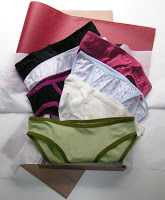
panty sampler

The End of Bgreen or Where Have All the Organic Panties Gone?

panty sampler

In the last few years, we have continued to lose best-selling panty styles.  First the cheeky Eat Organic bikini creators moved on to other ventures.  Then the whole line of PantyBoo bamboo underwear was discontinued.  Perfectly Imperfect, with their adorable lace-trimmed organic cotton panties and cross-your-heart thongs, went out of business.  Ecoland got mired in manufacturing issues and has not re-made their very popular hipster 2-pack in over a year.  The Love Nature Alba Bikini gave way to the more expensive ribbed version.  And finally, we’ve just lost our bgreen account.

After we’d been a wholesale client with bgreen for about 4 years, they decided to start selling retail.  Sadly, a few years on and they’ve now decided they can earn more money and better control pricing along with how their brand is portrayed by ONLY selling retail.  And alas, we can no longer restock any of their products including our #1 bestselling item in the entire store for the last 3 years running – the organic cotton Classic Bikini. 

As a quick side note, I have a lot of respect for bgreen.  They’re a vertically-integrated, eco-manufacturer working entirely in the USA and that’s really commendable.  However, one of the reasons they have a solid brand that they are concerned about maintaining a good reputation for, is that small businesses like mine have been selling and promoting their products and brand for many years.  So being cut out as it were, is very disheartening.

Over the course of the last 7 years, we’ve brought in a whopping 105 different styles of women’s panties. 37 are already permanently gone and 27 of the ones we’re still offering cannot be restocked.  And while my Things To Do List is already quite full, I’ve decided to make designing and launching our own organic panty line a priority.  I’m looking into branding it with a different name, (because I don’t think when we get to men’s underwear many of them will want to wear boxers labeled “Faerie’s Dance”… 🙂 and am hoping to launch the first couple of styles before the holidays if everything goes smoothly.

It will likely take more than a little while to bring in all the styles, fabrics and designs I’ve got in mind.  But the patterns and specs for the first two panties are complete and fabric samples are now rolling in. Thank you all for your continued patronage.  I hope you’ll love the new panties and look forward to getting started on this new venture.

Share this article:

Fair Trade Fashion Round-Up: Peau-Ethique

The French company Peau-Ethique (which roughly translates as skin-ethics), is next up on our Fair Trade Fashion Round Up.  Peau-Ethique is a member of La Plate Forme du Commerce Equitable, France’s national member organization to the World Fair Trade Organization.  Peau-Ethique concentrates on making intimates and nightwear that is organic, fair trade and beautiful.

Peau-Ethique works primarily in Turkey, where the majority of certified organic cotton is grown.  They have focused on lifting the lives of their manufacturing partners by:

  • Paying workers 20% more than the local minimum wage,
  • Partnering with a small factory that employs 90% women from poor neighborhoods,
  • Pre-paying their entire order to keep the producers out of dept,
  • Creating a long-term relationship to foster sustainable development,
  • Paying for employee meals and shuttle service.

They also work with a small artisan village in Peru providing the locals the means to stay in their village rather than having to move to the city for work.

Sublime bra by peau-ethique

Peau-Ethique was started by a lone women with a mission to improve the ethics and environmental impact of the fashion industry (just like FaeriesDance.com)!  Everything they make is Global Organic Textile Standard (GOTS) certified, and early on they won accolades for innovation in organic cotton and peace silk lingerie.  We’re impressed that Cathy Abruzzo both had the vision to make this eco-lingerie line a reality and took the time and money to get it fully Fair Trade certified.

Our first 3 fair trade company spotlights include a US company manufacturing in Peru, a UK company manufacturing in India and now a French company manufacturing in Turkey. It’s obvious that the fashion industry touches the entire world, and our clothing can make the world better or worse, as we choose. 

Share this article: